Silver: A Deep Dive into the Ultimate Conductor
oh, ahoy!
Silver has been prized for thousands of years as money, ornament, medicine, and metal. In the modern world, it holds a less romantic but deeply important distinction:
Silver is the most electrically conductive metal known.
This article takes a focused, practical deep dive into why that matters, how silver behaves, and where it earns its place despite its cost.
The Physics: Why Silver Conducts So Well
Electrical conductivity depends on how easily electrons move through a material. Silver’s atomic structure is nearly ideal for this.[1]
Key reasons:
- One loosely bound valence electron per atom
- Face-centered cubic (FCC) crystal structure
- Minimal electron scattering within the lattice
At room temperature, silver has the lowest electrical resistivity of any metal.
| Metal | Resistivity (Ω·m ×10⁻⁸) |
|---|---|
| Silver | 1.59 |
| Copper | 1.68 |
| Gold | 2.44 |
| Aluminum | 2.82 |
| Iron | 9.71 |
Lower resistivity means higher conductivity.
Electrical vs. Thermal Conductivity
Silver also dominates thermal conductivity.
- Best heat conductor among metals
- Rapidly transfers thermal energy
- Used in high-performance heat spreaders and interfaces
This dual excellence - electrical and thermal - is rare.
Tarnish: Silver’s Primary Weakness
Silver does not rust, but it does tarnish.
- Tarnish is silver sulfide, not oxide
- Caused by sulfur compounds in air
- Tarnish increases surface contact resistance, not bulk conductivity
Important nuance:
- Tarnish affects contacts, not the interior of the metal
- Under pressure or wiping contact, resistance drops again
- This is why silver is often plated, burnished, or self-cleaning in switches and relays
Why Copper Replaced Silver in Most Applications
If silver is better, why isn’t it everywhere?
Cost versus performance.
- Copper is ~95% as conductive
- Copper is vastly cheaper
- Copper oxide remains conductive (silver sulfide does not)
For miles of wire and tons of metal, copper dominates.
For precision, silver remains unmatched.
Applications Where Silver Remains Essential
Silver is used where failure is unacceptable or signal loss matters:
- Electrical contacts and relays
- RF and microwave components
- Silver-plated coaxial cables
- High-current bus bars
- Military and aerospace electronics
- Precision switches and breakers
Silver typically appears as:
- Plating over copper
- Alloys optimized for hardness
- Thick contacts that self-clean through use
Skin Effect and High-Frequency Behavior
At high frequencies, electricity flows primarily on the surface of a conductor (skin effect).
This makes silver ideal for:
- RF transmission
- Antennas
- Microwave waveguides
Silver plating dramatically reduces losses even when the underlying metal is copper.
Mechanical Properties and Structural Limitations
Pure silver is:
- Very soft
- Highly ductile
- Easily scratched or deformed
As a result:
- Industrial silver is often alloyed
- Jewelry uses sterling silver (92.5%) for strength
- Engineering applications balance hardness against conductivity
Chemical and Biological Notes
Silver has mild antimicrobial properties:
- Disrupts bacterial cell membranes
- Used in coatings, medical dressings, and water systems
This has nothing to do with conductivity, but it explains why silver appears in unexpected places.
The Big Picture
Silver occupies a rare intersection:
- Best electrical conductor
- Excellent thermal conductor
- Chemically stable
- Soft but highly workable
- Expensive but irreplaceable
It is not the metal of abundance.
It is the metal of precision.
Footnotes
[1] Silver crystal structure ↩
Silver crystallizes in a face-centered cubic (FCC) lattice.
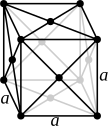
In an FCC structure, atoms occupy the eight corners of a cube
and the center of each of the six faces. This cubic unit cell
repeats uniformly in all directions, forming the bulk structure of metallic
silver. The FCC arrangement underlies silver’s high electrical and thermal
conductivity, strong reflectivity, and notable ductility: the metal deforms
plastically rather than fracturing.
Although the repeating unit cell is a cube, other geometric descriptions emerge when the structure is analyzed locally.

Each silver atom in an FCC lattice has 12 nearest neighbors.
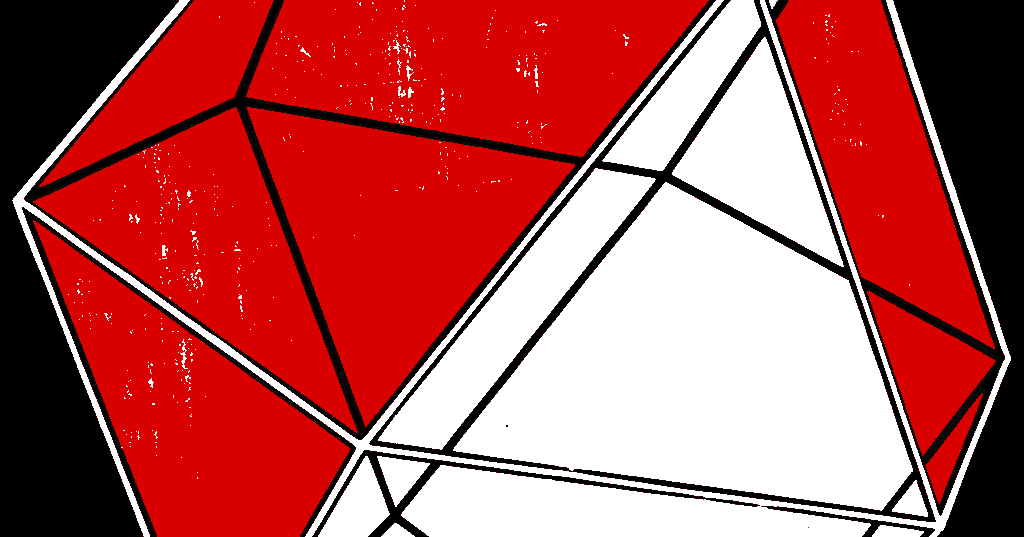
These neighbors form a cuboctahedron with
8 triangular faces and 6 square faces, describing the local
atomic environment rather than the repeating lattice itself.
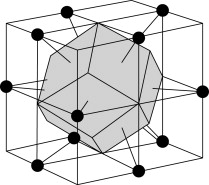
If space is divided so that every point is closest to a single atom,
the Wigner–Seitz construction of an FCC lattice produces a
rhombic dodecahedron. This polyhedron has
12 rhombus-shaped faces and represents how space is most
efficiently partitioned around each atom.
- Lattice type: Face-centered cubic (FCC)
- Unit cell shape: Cube
- Nearest-neighbor geometry: Cuboctahedron (12 neighbors)
- Wigner–Seitz cell: Rhombic dodecahedron